

Nantong Hi-eff Heat Exchange Equipment Co., Ltd. is a leading supplier of heat exchangers and their plates and gasket spare parts. Our main products are plate and frame heat exchangers, welded plate heat exchangers, plate heat exchanger accessories, etc.


Why choose us
Rich experience
Our team consists of more than 30 technical personnel with more than 20 years of industry experience and has helped our products obtain more than 55 patent certificates.
Accept ODM
Our team is good at customized design and production, and supports OEM and ODM orders, including providing various heat exchange tubes, fins, structural parts, and pipes to meet the requirements of different use environments.
Well equipped
The company is equipped with multiple advanced mold processing CNC machine tools, special hydraulic presses, punching machines, integrated blanking machines and other equipment, and can provide customers with high-quality heat exchanger and gasket spare parts, especially GEA, Tranter, APV, AGC and other models.
Quality assurance
We have our own quality inspection center to ensure that the production process complies with ISO standards, and conduct quality inspection of heat exchangers through hydraulic pressure testing equipment, strength testing equipment, etc. to ensure that all products comply with CE and RoHS certifications.
|
Model |
BL14 |
BL20 |
BL26 |
BL26C |
BL50 |
BL95 |
|
Width (mm) |
78 |
76 |
111 |
124 |
111 |
191 |
|
Height (mm) |
206 |
310 |
310 |
304 |
525 |
616 |
|
Length (m) |
9+2.3n |
9+2.3n |
10+2.36n |
13+2.4n |
10+2.35n |
11+2.35n |
|
Horizontal port distance (mm) |
42 |
42 |
50 |
70 |
50 |
92 |
|
Vertical port distance (mm) |
172 |
282 |
250 |
250 |
466 |
519 |
|
Max pressure [Mpa] |
3 |
3 |
3/4.5 |
3 |
3 |
21 |
|
Max flowrate (M3/h) |
8.1 |
12.7 |
39 |
8.1 |
12.7 |
39 |
|
Weight(kg) |
0.6+0.06n |
1.0+0.08n |
1.3+0.12n |
2.6+0.19n |
2.6+0.19n |
7.8+0.36n |
High heat transfer efficiency
In the plate structure, a special corrugated structure shape and spacing are adopted, and the fluid flow pattern is complex, and strong turbulence can be generated at a lower flow rate, so that the heat transfer ability can be exerted to a certain extent and higher The heat transfer performance.
Wide range of application
Its special all-welding process does not require non-metallic materials for sealing, and its structural design is diversified, which can be applied at higher temperatures and pressures.
Low pressure loss
The special plate corrugated structure makes the fluid fill the flow channel formed between the plates, and all the plate surfaces participate in heat exchange. The medium can flow without dead zones in the flow channel, which can reduce the consumption of kinetic energy to a certain extent and save operating costs.
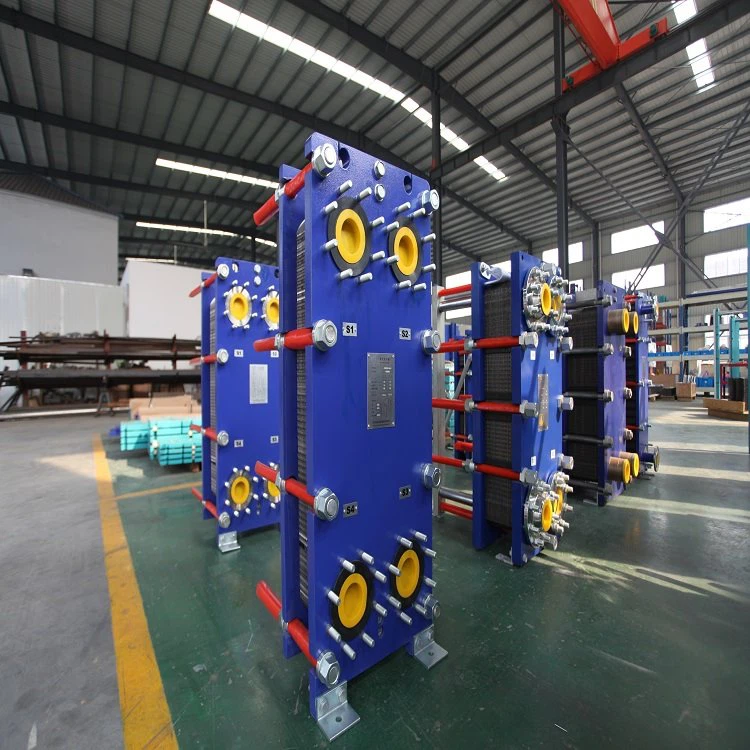
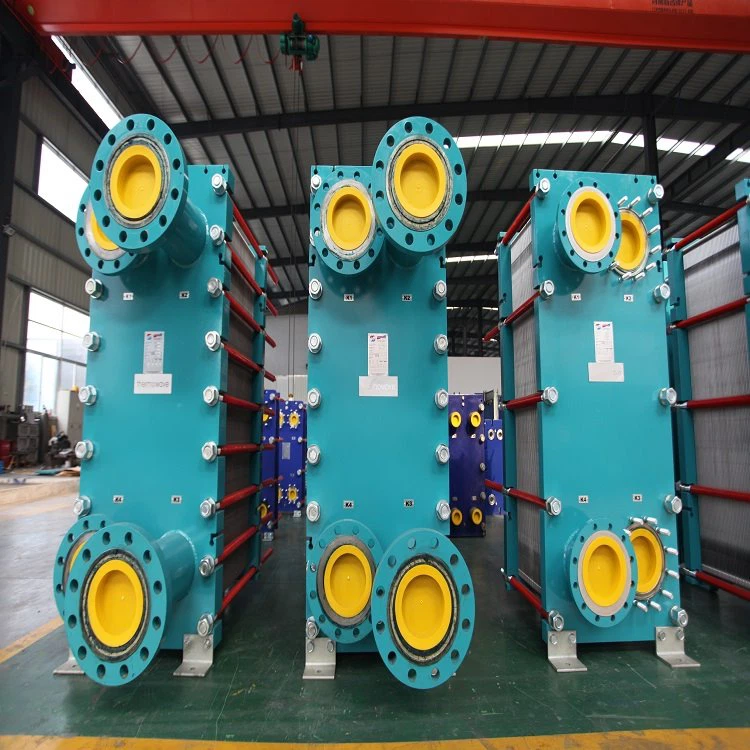
Compact structure, small footprint
The fully welded plate heat exchanger has a compact structure and a wide range of applicable space conditions. The heat exchange area per unit area is 2 to 5 times that of the shell-and-tube type, and there is no need to reserve maintenance space for extracting the tube bundle. When realizing the same heat exchange task, the area of the fully welded plate heat exchanger is about 1/6-1/10 of that of the shell-and-tube heat exchanger, which can greatly reduce the capital investment cost.
Not easy to scale
The heat exchange plates are welded around, and during operation, they are affected and restricted by thermal stress, so that the inside of the plates can expand and contract freely, so the surface of the plates is not easy to scale.
Material of welded heat exchangers
Austenitic steel
DIN 1.4404, DIN 1.4571 (water, weak solutions of NaOH and HNO3, oilds, steam, freons, NH3).
Superaustenitic steel
DIN 1.4539, DIN 1.4547 (substances with higher chloride content, NaOH solutions, HNO3).
Nickel alloy
DIN 2.4610, DIN 2.4819 (acids H2SO4, HCl, HF, H3PO4, organic acids, alkalis and salts).
Titanium alloyes
DIN 3.7025 Gr.1, Gr.2 a Gr.7 (higher content of chlorides, brine, chlorine, NaOH, HNO3, H3PO4, weak acids H2SO4, sea water).
Application of Fully Welded Plate Heat Exchangers
Chemical industry
Used in chemical reactors to improve reaction efficiency;
Metallurgical industry
Used for cooling high-temperature flue gas and recovering heat energy;
Food industry
Used for refrigeration and heating;
Air conditioning industry
Used for cold and hot exchange in indoor central air conditioning systems.
Packaging

Transportation

Our company has advanced machines and skilled workers, which can meet the needs of various enterprises

Certification


FAQ
As one of the leading fully welded plate heat exchangers manufacturers and suppliers in China, we warmly welcome you to buy high-grade fully welded plate heat exchangers for sale here from our factory. All equipment are with high quality and competitive price. For quotation, contact us now.
Fully Welded Plate Heat Exchangers, Plate shell Type, Plate Frame Type