

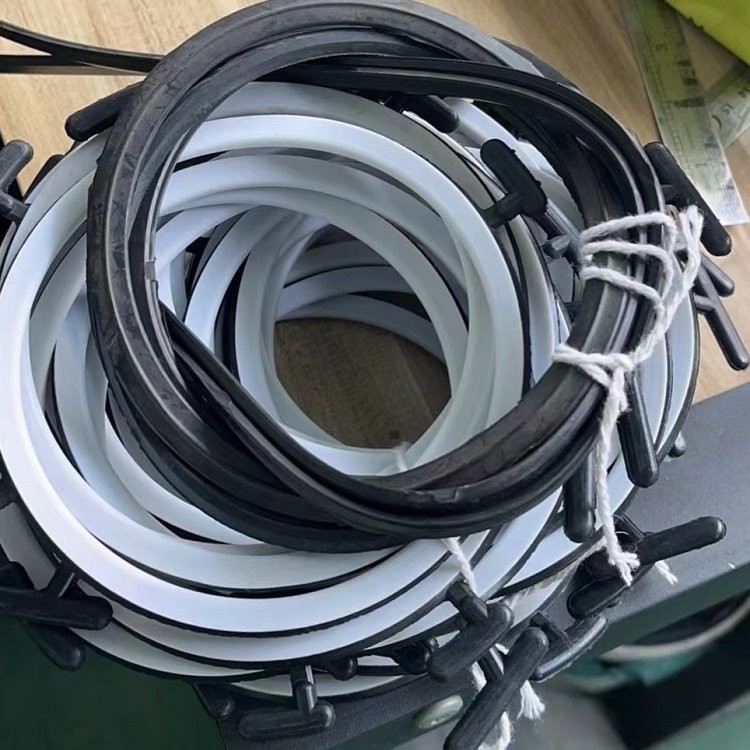
The heat exchanger is an important component of the plate heat exchanger. During assembly, adhesive is used to firmly attach the gasket to the sealing groove of the plate, and the gasket is placed in the circumferential groove of the hole according to the needs of fluid flow, thereby ensuring or preventing fluid from entering the channel between the plates and achieving the purpose of heat exchange. The material, structural form, and compression ratio of the sealing gasket are directly related to the sealing effectiveness of the plate heat exchanger. The commonly used sealing gasket materials currently include synthetic rubber and asbestos rubber. Synthetic rubber often uses nitrile rubber, ethylene propylene diene monomer rubber, and fluorine rubber. The physical performance indicators of synthetic rubber heat exchanger depend on the permanent compression deformation and elongation at break under operating conditions. The hardness indicators of rubber sealing gaskets should be determined based on the form and compression amount of the sealing groove.

There are also many structural forms of sealing gaskets, with roughly rectangular, trapezoidal, hexagonal, pentagonal, and other cross-sectional forms. There are two types of commonly used forms: one is the form where the upper section of the sealing gasket is pointed; Another form, with a flat upper part. The former increases the deformation degree of the sealing gasket through the difference in size from the tip to the middle. In fact, its structural design is still a planar seal, while the nonlinear seal is because the bottom of the sealing groove of the plate is a plane.

When there are defects in the bottom plane of the sealing groove of the plate, this structure can counteract some of them. The purpose of the latter design is to reduce the compression of the heat exchanger, and its compression form is flat compression. Its main drawback is that during the process of plate assembly, the plates are prone to misalignment, excessive clamping force, and deformation. Through analysis research and experiments, the gasket section corresponding to the sealing groove is shown, which simplifies assembly and improves the pressure bearing capacity of the plate. The ratio of the tightening amount of the sealing gasket to its original thickness, also known as the tightening ratio, is used as the design basis for the sealing gasket.

Based on years of design experience and analysis of the sealing structures of a large number of plate heat exchangers both domestically and internationally, the author believes that a tightening ratio of 20% to 25% is ideal.
Hot Tags: heat exchanger gasket, China heat exchanger gasket manufacturers, suppliers, factory